
Schuyler, Fort
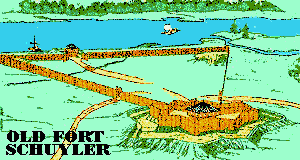
Fort Schuyler (4): 1833-1911, Bronx County, Throngs Neck. A tract of 52 acres was purchased by the Federal Government from William Bayard in 1826 and construction of the fort began in 1833. This was intended to close the western end of the Sound and thus protect New York from attack by sea from this direction. Originally a companion to Fort Totten on the opposite shore. In December 1845, the fort was ready for its armament of 312 seacoast and garrison guns, six field pieces and 134 heavy guns. The installation of the armament was completed in 1856, and the fortification was named Fort Schuyler, in honor of General Philip Schuyler. The fort was built of granite brought from Greenwich, Conn., in an irregular pentagon, and was built to accommodate a garrison of 1,250 men. Three full bastions at the salients of the waterfront, two demibastions flanking the gorge on the land front, and the bastioned coverface and covered way protecting the land side were armed for firing from every angle. The fort had two tiers of guns in casemates and one en barbette. The casemates had two embrasures each. Two gun embrasures and one howitzer embrasure were closed later on to make room for a torpedo casemate. On the land side, approach was over a drawbridge, after the manner of a medieval castle. This opened into a tunnel with narrow slits in each side for riflemen who thus would be able to pour a heavy fire upon any attacking force from that quarter. In 1864 was used for 500 Confederate POWs. In 1868 ten Rodman guns were mounted in casemates of the first tier and these in turn were replaced later by eight-inch rifles. Construction of modern defenses was begun in 1896. Under this program two ten-inch and two twelve-inch guns on disappearing carriages; two five-inch rapid fire guns, two fifteen-pounders and battery commanders' stations for the ten-inch and twelve-inch batteries were installed. After October 12, 1870, the post stood abandoned; but three years later work was begun on widening the terreplein of the north and east waterfronts for barbette batteries of fifteen-inch guns, leaving the emplacements unchanged on the south front and the demibastions of the gorge. This work was suspended in 1875 for the want of funds. Batteries in 1921 were as follows;
Battery Gansevoort, 1 - 12" Disappearing (1 empl vacant)
Battery Hazzard, 2 - 10" Disappearing
Battery Bell, 2 - 5" Pedestal
Battery Beecher, 2 - 15 pdr
AA, 2- 3".
For more information see Coastal Defense Study Group (link opens new window)
Marginal use continued until 1911 when it was closed. Most of its guns were stripped for scrap during WW1. In 1931 the site was leased for the NYS Merchant Marine Academy. Now part of New York's Maritime College (SUNY), with several of the original casements renovated into a library.