
<< Back to Forts
Frederick, Fort
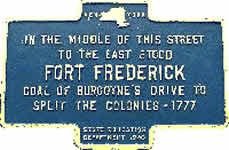
Description: Fort Frederick, 1676, Albany County, Albany. Originally a stockade of wood construction which replace Fort Orange which was on the river. It was rebuilt as a masonry fort between 1702-35, on State Street hill (21 guns), originally with a stockade that enclosed the city. Torn down about 1789. Referred to in "Drums Along the Mohawk" as Fort Albany. A letter 2 April 1703 mentions a new fort is being built.
The following was taken from "The English Stone Fortress: Fort Frederick" by William Glidden. It appeared in the September 17, 2003 issue of the Lake Champlain Weekly.
War clouds were again threatening in 1702 with the efforts of Louis XIV to place his grandson, Phillip, on the throne of Spain. Britain feared that such an event would enable France to monopolize the trade of the Spanish Empire. On May 15, 1702 Great Britain and the Netherlands declared war against France -a war known as the War of Spanish Succession in Europe and as Queen Anne's War in North America.
In North America, Edward Hyde, Viscount Cornbury, cousin of Queen Anne, arrived as a kind of commander-in-chief. As Royal Governor of New York and the first Royal Governor of New Jersey, he was invested with wide authority to improve the English colonists' military posture.
The first measure Cornbury sought was to shore up the crown's alliance with the Iroquois by strengthening the faction within the Five Nations of the Iroquois that favored the English. His objective was to restore their confidence in England's firmness of purpose. By the late summer of 1702 at a council meeting with the Iroquois in Albany, he announced that he would rebuild New York's frontier forts, providing protection for both the English and their native allies. He also advocated that only a military force from England directed against Quebec could defeat the Canadians.
While in Albany, Cornbury undertook to replace the stockaded fort with a new one of stone. Plans were set in motion to have the fort redesigned and relocated to higher ground in order to provide better defense at a lower cost. On August 15, 1702 the cornerstone of the new fort was completed, and he expected the walls to reach five feet in height before the first frost. This was the very proof that the Iroquois and Hudson River Indians wanted of England's concern for their well-being, and it led them to praise the governor's justice and circumspection. Governor Cornbury unofficially called the new fort "Fort Anne."
On September 24, 1702, Cornbury wrote to the Lords of Trade: "The fort is in a miserable condition. It is a stockaded fort about one hundred twenty feet long and seventy feet wide. The stockades are almost all rotten. There is but 23 guns in the fort, most of them unserviceable.
Thus we were busyed when Mr. Romer arrived at Albany, which was on the 19th day of August, by which time I had laid the foundation of 2/3s of the fort. And I do well hope that before the frost it will be five feet high which will be a good breast work til next spring."
Cornbury also informed the Lords of Trade that he had more progress on the fort in a few weeks than Colonel Romer, the imperial engineer, had done in a year and a half. Nor did he hesitate to redesign the fort and relocate it to higher ground. He then demanded an audit of Romer's accounts. Friction flew between the two of them.
Cornbury's actions gained the support of Albany's magistrates. Where as the magistrates previous requests for protection had gone unanswered, Cornbury had actually begun construction of a new stone fort large enough to shelter them and their native allies. Cornbury also proposed the construction of four other forts or stone redoubts on the frontier, and in time of war a force of six hundred to man them.
The imperial officer Colonel Robert Quary confirmed that the new fort gave "great satisfaction to our Indians, who lay the great stress of their security on the defense of those forts."
On June 18, 1703 Colonel Robert Quary wrote to the Lords of Trade: "My Lord Cornbury hath laid the foundation of a stone fort at Albany, and hath carried it on a great way. It will be very regular and answer the end."
Emphasis on Albany's defense continued following Cornbury's administration. Acts were passed for repairing the blockhouses, platforms and other fortifications during the administration of Governor Robert Hunter on November 28, 1711, May 7, 1711, July 25, 1715 and on October 2, 1716. Queen Anne's War officially ended with the signing of the Treaty of Utretch on April 11, 1713.
Measures were taken in Albany during the years following Queen Anne's War. Acts were passed on October 16 and November 21,1724, during the administration of Governor Burnet to improve security, which included plans for building new blockhouses. Later the blockhouses were fortified with "great guns." With increased activity by the French in the Lake Champlain country, President Van Dam of the New York Assembly reported on September 11,1731 to the Duke of Newcastle that they had voted during the last session that they would in their next take into consideration the building of the fort at Albany.
Construction began in 1734 on a new wall around the city. The newer portions of the wall were stone by 1735. Governor William Cosby reported to the Board of Trade on June 10, 1735 that an act had been passed during the last year for fortifying the cities of Albany and Schenectady and other places in the County of Albany. A county laid out northward to the French frontiers.
It was finally reported to the Board of Trade on June 2, 1738 that the stone fort was completed at last and named "Fort Frederick" in honor of Frederick Louis, the eldest son of King George II of Great Britain. It was a 200-foot square structure with a bastion at each corner. Within the structure a single, long, brick two-story barracks existed alone one curtain wall and an equally long two-story brick "Governor's House" along the opposite side. Each building had bedsteads for 40 men. A garrison of 300 could be maintained in the fort. The fort mounted eight or ten cannon, most of them 32-pounders.
The fort stood throughout the colonial wars. Its existence was proof of England's determination in defending the English colonies and its native allies. However, by 1785 Albany's Common Council decided that the fort at the head of State Street had served its usefulness and should be torn down. The remains of Fort Frederick were used by workmen for the widening of State Street. Much of the stone was also carried off by officers of the different churches to be used for building purposes. At the site of Fort Frederick now stands St. Peter's Episcopal Church within which Colonel George Munro of Fort William Henry fame and George Augustus, Brigadier General Viscount Howe, a significant loss in the expedition against Fort Carillion in 1758, are now buried.
County: Albany County
City, State: Albany, New York