
<< Back to Forts
Brindley Field
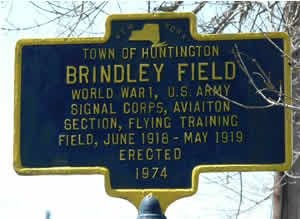
Description: During World War I, the community produced food for the war effort. In June 1918, an aviation camp, Brindley Field, was set up on the corner of Jericho Turnpike and Larkfield Road. It became the home of the 211th Aero Squadron for advanced airplane training. The base was deactivated in May, 1919.
From: www.eastnorthport.com/townhistory.htm [link opens new window]
Q. What about Brindley Field?
A. Well the Brindley Field was another highlight experience too. The first thing we knew of Brindley Field, or any activity of it occurring there, was in June 1918. The first sight of any of this activity was a long line of army trucks coming up the old Jericho Turnpike with soldiers in them. To see a truck of any kind was a unique experience in those days. They just didn't exist in Commack. And they came around the corner into Larkfield Road, or it was known as Larkfield Avenue in those days, and pulled right into the gates of the property on the north east corner of Jericho Turnpike and Larkfield Avenue. Then we learned, or I did, that it was to become a training field for aviators to be sent to France during W.W.I to be fighter pilots.
The field itself consisted of ninety acres of land, with the buildings, and barns, one large barn, and several other storage barns of a smaller size, and other out buildings. Ana a main house which they immediately established as a headquarters for the field. From that time on, for the next month or so, the place blossomed out into a tent city. I'd say up until the middle of July it was a tent city, with all the troops stationed there.
The first thing I remember being built in there, in the way of buildings, was the mess halls where the soldiers had to go to eat their meals. The next permanent buildings being built were the barracks for the men to sleep in. In the beginning the tent city was used as their sleeping quarters. I also remember the set up of officers tents, and the medical center in a tent.
The army provided medical officers there to take care of the troops health. One we knew, and became quite friendly with, an older army officer, a Lieutenant Frachs who came from Missouri, a real old timer, a real army man. We became friends with a number of others in the period of three to four months that the field was in real full operation.
Then about the first of August they built quite a number of barracks. I think all together about sixteen or twenty of them all together. They were built along the north side of Jericho. The nearest barrack was just inside the fence line on the pike.
Speaking of the barracks, the first electricity to reach Commack was brought to Brindley Field purposely to light up the barracks. That was a line that ran down Larkfield Ave. The problem there was these high-tension lines were right in the path of some of the take off points of the planes. The government got Lilco to move the high-tension lines back west a thousand feet off the main road and that cleared the way for there take off. When the wind was to the west they had to take off in that direction and it wasn’t safe with the wires there. Those lines ran right down to the barracks. What a sight to see thousands of lights all concentrated in one area! It was quite a shocker so to speak. Up to that time we were using oil lamps for light.
The field was protected everyday by guards who would walk the parameter of the field. After July there were no more visitors allowed inside the camp. I had some access in the beginning being a kid, but they gradually phased me out.
Towards the end of that summer they found they needed more space so the rented some more land to the east. In one case they had to condemn the land from the owner, but only temporarily. They did some considerable clearing of woodland in the north east corner of the property. They cleared that area of trees entirely. They cut them down, removed the stumps, and graded it off. That was quite a project. Then they felt they had enough safe room to feel satisfied with.
In September of 1918 the war was coming quite rapidly to a close and I can remember the newspapers with the headlines and photo’s of who’s where, and what the army did. At this time in September some people rented land from us on the west of Larkfield Ave. across from the camp to open up an eatery for when the soldiers were off duty. They had a little building and sold food and drinks, and along with that newspapers.
In August of 1918 they started to build five big steel hangers, the nearest one was about one hundred and fifty feet from Larkfield Ave. They stood in a line behind the original hay barn that had been used to hold airplane parts at that time. They were for what we called Jenny planes at the time.
This field was a satellite field of Mitchell Field in Mineola and was the last training field for flyers before they went to France. It was a very important field at the time and sometimes other planes would fly in for a few days Some were the DH-4 with the most powerful engine at the time. It was designed in 1918 by these five guys hired to make the best engine they could for the war.
In the last days of the war the newspapers had more headlines of what had been accomplished. Then came the Armistice in November and the people were quite happy.
Q. What happened with the plane crash?
A. They had dog fights in their training over the field and surrounding areas. One of the most serious accidents happened while they were having dog fights over the Havemeyer property east of Townline Road. Two pilots were killed when their plane crashed into the ground after loosing control. What happened was one of the wings crumbled. It as the only death during all that flying time.
I can actually remember when the accident happened because someone had come over to our house and told us that there had been a crash over in east Commack. In the medic's hurry to get there they tried to go straight instead of taking the roads and that was a mistake because they ran into hedgerows and had to take down fences. But it was no use to save them because they were both killed outright.
There was quite a service held for the two pilots at Mitchell Field, and then they were shipped by train one to California, and one to Pennsylvania
*****
"Let there be light!" Between 1921-23, electricity was wired into the church. There was none in Comac until after 1918, since Brindley Field in Comac was responsible for bringing it for its own use during World War I, and it became available to homes, stores, and the Church.
From: https://www.commack.church/history
County: Suffolk County
City, State: Commack, New York
History:
Photographs and information compiled and submitted by Mark R. Wilkinson
Town of Huntington
Brindley Field
World War 1, US Army
Signal Corps, Aviation
Section, Flying Training
Field, June 1918 - May 1919
Erected
1974
In Memoriam
On Aug. 16, 1918 an aircraft
accident at this site
claimed the lives of 2nd Lts.
C.C. Gideon and Harold Maxon
Stationed at Brindley Field.